


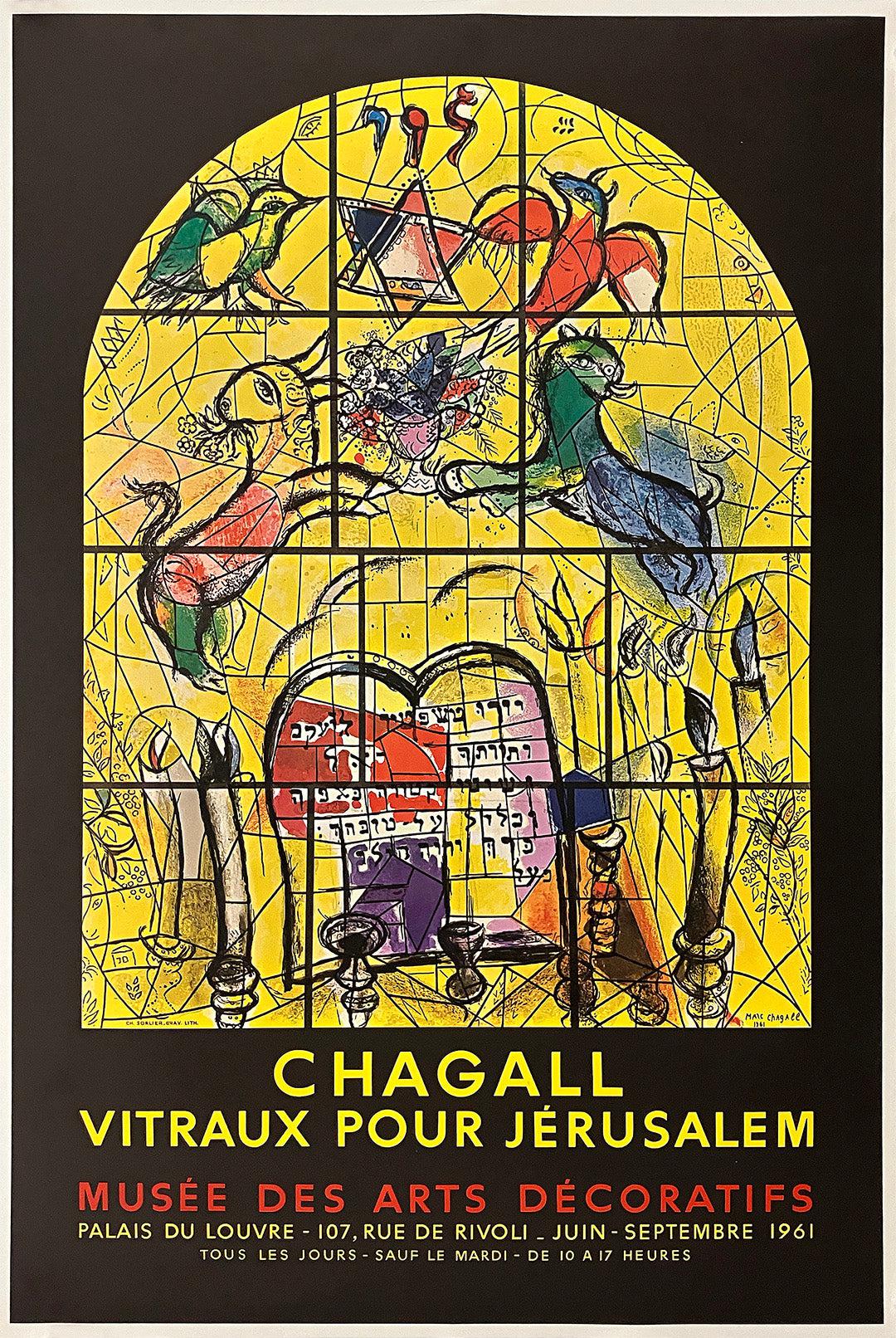
Vitraux Pour Jerusalem - Musee des Arts Decoratifs
Vitraux Pour Jerusalem - Musee des Arts Decoratifs
(54x84cm)
Couldn't load pickup availability
Shipping Info
Shipping Info
- All posters ship within 1–2 business days
- Each poster includes an individually signed Certificate of Authenticity. More Info
Buy with Confidence
Buy with Confidence
Returns accepted within 7 days of receipt. See our full return policy.
FAQs
FAQs
See answers to our most common questions, here
Looking to Sell?
Looking to Sell?
We are always interested in acquiring special pieces. Let's get in touch!
Marc Chagall's "Windows for Jerusalem," displayed at the Musée des Arts Décoratifs in Paris, is a stunning series of stained glass windows created in 1961. Commissioned for the Hadassah Medical Center in Jerusalem, these windows are celebrated for their vibrant use of color and symbolic imagery. Chagall's design integrates Jewish themes and biblical stories, blending his signature style with religious and historical references. The windows feature intricate patterns and rich hues, illustrating the artist's unique ability to convey spiritual and cultural narratives through stained glass. This work not only showcases Chagall's mastery of color and form but also serves as a profound tribute to Jewish heritage and the city of Jerusalem.
Marc Zakharovich Chagall, born Moishe Zakharovich Shagal (24 June 1887 – 28 March 1985), was a Russian-French artist of Belarusian Jewish origin. An early modernist, he was associated with several major artistic styles and created works in virtually every artistic format, including painting, book illustrations, stained glass, stage sets, ceramic, tapestries and fine art prints.
Art critic Robert Hughes referred to Chagall as "the quintessential Jewish artist of the twentieth century" (though Chagall saw his work as "not the dream of one people but of all humanity"). According to art historian Michael J. Lewis, Chagall was considered to be "the last survivor of the first generation of European modernists". For decades, he "had also been respected as the world's preeminent Jewish artist". Using the medium of stained glass, he produced windows for the cathedrals of Reims and Metz, windows for the UN, and the Jerusalem Windows in Israel. He also did large-scale paintings, including part of the ceiling of the Paris Opéra.
Before World War I, he travelled between Saint Petersburg, Paris and Berlin. During this period he created his own mixture and style of modern art based on his idea of Eastern European Jewish folk culture. He spent the wartime years in Soviet Belarus, becoming one of the country's most distinguished artists and a member of the modernist avant-garde, founding the Vitebsk Arts College before leaving again for Paris in 1922.
He had two basic reputations, writes Lewis: as a pioneer of modernism and as a major Jewish artist. He experienced modernism's "golden age" in Paris, where "he synthesized the art forms of Cubism, Symbolism, and Fauvism, and the influence of Fauvism gave rise to Surrealism". Yet throughout these phases of his style "he remained most emphatically a Jewish artist, whose work was one long dreamy reverie of life in his native village of Vitebsk." "When Matisse dies," Pablo Picasso remarked in the 1950s, "Chagall will be the only painter left who understands what color really is".
This is an Original Vintage Poster; it is not a reproduction. This poster is printed on heavyweight paper and in excellent condition. We guarantee the authenticity of all of our posters.
What Does 'Original' Mean?
We only deal in original vintage posters, never reproductions. This means that every poster is from the original print run, in the year listed in the description. Everything we sell comes with an individually signed certificate of authenticity, which we fully guarantee.